1987

Oxley9 9_87 (1)#6CB8

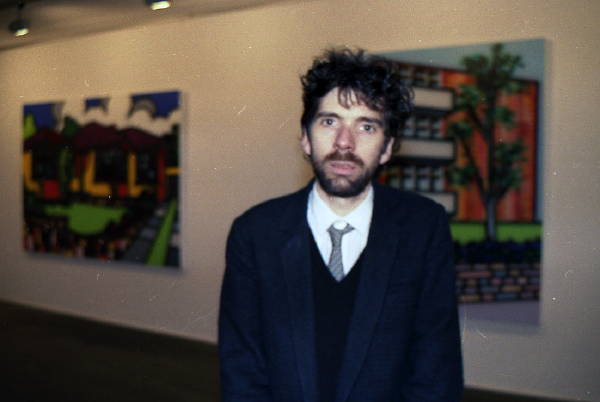
(photo: the artist at the opening of his Roslyn Oxley9 exhibition, 2 Sept.1987 [archive photo])

Arkley staged two solo painting exhibitions, showed several new work-on-paper cacti in Brisbane, and was prominent in a number of significant local group exhibitions during the year. The solo show at Roslyn Oxley9 in September was his first in which the suburban theme – such a key factor in his subsequent career – was clearly to the fore. The Anima Gallery exhibition in Adelaide mostly comprised canvases already shown previously.

In the ‘Ten by Ten’ group show at 200 Gertrude Street, painter Lesley Dumbrell selected Arkley among ten of her peers (also including Elizabeth Gower, John Nixon, Peter Tyndall and Jenny Watson) whose work had been significant ten years earlier, comparing their recent works to guage their development. In some cases, continuity was apparent, but with Arkley (as with Jenny Watson), the change was dramatic.

Juliana Engberg published a major profile in the Autumn issue of Art & Australia (‘Indigenous, indelible Arkley’), providing an insightful survey of his career and critical fortune to date. She stressed the innovative nature of his visual language, and the significance of his suburban subject, predicting that this would soon dominate his work. Other significant publications – see bibliography – included a substantial review of Arkley’s Roslyn Oxley9 show by John McDonald (for further comments, seer exhibition entry).

In April, Arkley married artist Christine Johnson, whom he had met in 1986 (see Preston 2002: 144ff.). He exhibited alongside her in the group show at Ormond College (Nov.-Dec.), and also worked with her on at least two collaborative works (not acknowledged as such until after Arkley’s death): Suburban Window 1987 [aka Suburban Landscape] [Howard Arkley & Christine Johnson] (shown at the Roslyn Oxley9 show in September), and Suburban Landscape 1987 (refer catalogue entries for further details). Other planned collaborative works apparently failed to eventuate (see Carnival 147 for further discussion).


1987 Exhibitions

‘Australian Art 1960-1980: Field to Figuration: works from the National Gallery of Victoria’, NGV, 21 Feb.– 29 March 1987 [for catalogue, see Lindsay 1986]

‘Young Australians’ (Budget Collection) NGV etc. [catalogue ed.Robert Lindsay: in HA files]

‘Selected Contemporary Drawings’ Heide, Oct.1987 [cat.in Arkley files]

‘Ten by Ten 1975-1985’ 200 Gertrude St., 20 Nov.-12 Dec.1987 [cat.in Arkley files]

Works on paper group show: Howard Arkley, Elizabeth Gower, Tim Johnson, Scott Redford, Bellas Gallery, Brisbane, June 1987 [copies of check-list and reviews (see Petelin 1987 and Woolcock 1987) in Arkley’s  files; each work priced at $1300]:

‘Howard Arkley: Suburban Urban Messages’, Roslyn Oxley 9, Sydney, Sept.1987

– refer linked entry for full details

‘Works by Howard Arkley’, Anima Gallery, Adelaide, Oct.- Nov.1987

– refer linked entry for full details

‘Ormond College Welcomes New Art’, Melb.U., 22 Nov.-6 Dec.1987 (cur.Tony Clark; catalogue: Clark 1987; copy in Arkley’s archive)

‘What is This Thing Called Science’, University Gallery, University of Melbourne, 11 November – 18 Dec.1987 (catalogue: Cass 1987)


Tudor House 1987

Synthetic polymer paint on canvas, 160 x 122

Signed, dated & titled on verso

Private collection, Melbourne

Both this canvas and the closely related variant English Style (1987) were developed from the imagery first explored in 1986 in Arkley’s two Tudor Village paintings. The composition of both 1987 canvases closely echoes a photocopied source image preserved in Arkley’s archive (reproduced in Duncan 1991, p.25).

The present canvas was purchased directly from Tolarno Galleries in March 1987, together with Modern Agriculture 1987, and both paintings were later included in the 1991 Arkley survey exhibition at Monash University.

[NB new entry, Oct.2023, with thanks to Chris Deutscher and Sarah Ritson for clarifying provenance details]

Provenance

  • Tolarno Galleries, Melbourne
  • Collection of J.and H.Ritson, Melbourne, acquired from the above, March 1987
  • Deutscher-Menzies, private sale, May 1999
  • Private collection, Melbourne

Exhibited

  • HA Monash 1991, cat.68 (details as above)
  • HA Metro 5, 2/02, cat.9 (ill.)


Flower Head 1987 [W/P]

Synthetic polymer paint on paper, 76 x 56

Signed, dated and titled (verso inscriptions)

Private collection, Melbourne

This work, inscribed on the verso with the title “Flower Head. Portrait series” is obviously closely related to the group of cactoid compositions shown at the Bellas Gallery in June 1987: see e.g. Domestic Agriculture(1987) [W/P].

The inscription incorrectly identifies the work as on canvas, 760cm x 560cm.

Provenance

  • Purchased from the artist by the present owner, c.1987

Untitled (“Bunch of Flowers”) (1987) [W/P]

Synthetic polymer paint on coloured paper in wooden frame, 30 x 23

Inscribed at lower margin: “To Sue with love and good luck in Brisbane / from Howard xx…”

Collection of Sue Cramer

This work typifies Arkley’s more informal, “minor” works on paper – here a gift for Cramer on the occasion of her taking up the post of Director of the Institute of Modern Art in Brisbane (1987-89). A well-respected critic and curator who also owns Arkley’s Untitled [Zappo study] (1983) [W/P], she is now a curator at Heide Museum of Modern Art in Melbourne (for her CV, see e.g. http://alumni.online.unimelb.edu.au/s/1182/match/wide.aspx?sid=1182&pgid=2077&gid=1&cid=3109&ecid=3109&post_id=0 [May 2012]).

The exact line of demarcation between such works and Arkley’s major works on paper is hard to define; the inclusion of this example in the Arkley survey at the TarraWarra Museum of Art in 2015-16 (in the “friends” section of the show) helps sway the decision to catalogue it here.

Provenance

  • as above

Exhibited

  • HA TarraWarra 12/15-2/16 (as Bunch of Flowers 1987; ill.)


Suburban Landscape 1987 [Howard Arkley & Christine Johnson]

Alternate title: Suburban Landscape (Spotted Dog and Spotted Curtain)
Synthetic polymer paint on canvas, 160 x 120
signed, dated and titled
 [on reverse: ‘Howard Arkley ’87 / Suburban Landscape (Spotted Dog and Spoted {sic} Curtain’ (acc.to Christie’s 11/92)]
Private collection, Melbourne

This canvas first appeared in the Greenpeace artists’ benefit exhibition held at the Linden Gallery, St Kilda, in 1990: see Lew 1990, and Trioli, “The Green-Art Effect” 1990, both with reproductions clearly showing this work.

It is a closely similar variant of Suburban Window 1987 [Howard Arkley & Christine Johnson] (exhibited at Roslyn Oxley9 in Sept.1987), only differing in a few details, notably in the garden outside, which is considerably more colourful and less heavily shadowed in the present version.

But it retains the central notion of an “obvious stylistic disparity” noted by John McDonald in 1987 in relation to the first version – an idea that Christine Johnson recalls had proved popular, thus explaining the production of a replica (telephone communication, 5 October 2015). For more detailed comments on this collaborative process, see the entry on the Roslyn Oxley9 painting, and Victoria Lynn in the 2015 TarraWarra catalogue, mentioning “at least two” versions of this composition (citing Johnson). Unfortunately, my own discussion of the work in Carnival in Suburbia, in the context of Arkley’s collaborative career, is accompanied by an inaccurately coloured reproduction based on a slide in Arkley’s archive, and incorrectly titled Suburban Window.

The canvas was included in Christie’s November 1992 auction of works from the estate of Georges Mora (who died on 7 June 1992), as Arkley’s work alone, with the title and and other details as noted above. It may also have been auctioned the year before, by Sotheby’s (see provenance details below), although there is no catalogue photograph, and it is unclear who owned the work at the time.

[NB in a previous entry on this work in the present catalogue, provenance and exhibition details for this work were inadvertently conflated with those of the Roslyn Oxley9 painting, also dated 1987. For their help with disentangling the complex history of both pictures, thanks are due to Christine Johnson, Victoria Lynn and Anthony Fitzpatrick in 2015, and Asta Cameron from Menzies Art Brands, Feb.2025, ahead of the auction of the present canvas in April 2025]

Provenance

  • (presumably) auctioned by Sotheby’s, Melb., 19 Aug.1991, lot 156, as Howard Arkley: Suburban Landscape (Spotted Dog and Spotted Curtain) (not illustrated; est.$3-5,000; not sold)
  • auctioned by Christie’s, Melb., 24 Nov.1992 (‘The Estate of Georges Mora’), lot 18, as Howard Arkley: Suburban Landscape (Spotted Dog and Spoted [sic] Curtain) (160 x 120 cm; B&W ill.; est.$3-5,000; sold for $2,800 plus buyer’s premium)
  • Private collection, Melbourne
  • auctioned by Menzies, Sydney, 9 April 2025, lot 31: ill., details as shown here; est.$120-160,000; sold for $120,000 + buyer’s premium

Exhibited

  • Linden Gallery, St Kilda, 7/90 (‘Greenpeace Artists’ Benefit’): as Howard Arkley: Suburban Landscape 1987 (courtesy Tolarno Galleries)
  • HA TarraWarra 12/15-2/16 (details as above)

Literature

  • Lew 1990 (with photo of Arkley standing in front of the work)
  • Trioli, ‘The Green-Art Effect’ 1990 (Age EG cover story on the Greenpeace exhibition, with colour reproduction)
  • Litson 2001 (including Christine Johnson’s comments on the composition)
  • Carnival 147 and Fig.5.7 (as Suburban Window, by Arkley & Johnson)
  • Fitzpatrick & Lynn, Howard Arkley and Friends (2015), pp.51-52 (Victoria Lynn)

After Durer’s illustrations, Treatise on Measurement (1525) 1987 [W/P]


(presumably) Fibre-tipped pen and photocopy on paper, {size unknown}

signed and dated (monogram, upper centre): ‘HA 1987’

Coll.: unknown

This working drawing was reproduced in the catalogue of the exhibition ‘What is this Thing Called Science’, shown at the University of Melbourne Gallery late in 1987, which included the completed canvas After Durer’s illustrations, Treatise on Measurement (1525) (1987). Both works obviously derive from an Albrecht Dürer woodcut illustrating his treatise on the theory and practice of perspective (1525).

A prominent addition is Arkley’s own ‘HA 1987’ monogram, modelled on Dürer’s famous ‘AD’ signature (a variant is preserved in Arkley’s studio archive). For comments on this motif, and Arkley’s general interest in the German artist, see Carnival in Suburbia (2006), 94.

Provenance

  • Unknown

Literature

  • Cass 1987, 15 (ill)
  • Carnival in Suburbia, 94


Zappo Head

= Zappo Head 1985 [W/P]

Triple Fronted 1987

Synthetic polymer paint on canvas, 169.9 x 241.9 (x 5.5)

Signed, dated and titled [on reverse: ‘Triple Fronted / 1987 / … Howard Arkley’]

Art Gallery of New South Wales, Sydney [Mollie and Jim Gowing Bequest Fund 2014]

This canvas was first shown at Roslyn Oxley9 in Sydney in September 1987, and then the following year at Tolarno, in each case providing eloquent testimony to Arkley’s emerging focus on the suburban theme.

Reviewing the 1988 Tolarno show in Agenda, Juliana Engberg commented that this ‘epic’ suburban image ‘monumentalizes the everyday’. Subsequent opinion has reinforced that view of this iconic work. However, many later commentators seem to have missed Engberg’s further, subtle point, that after viewing works like this, ‘… it is impossible to continue to consider the suburbs as dull pockets of frustration and stagnation, rather it must be said that through Howard Arkley we see suburbia as a place of colour, nuance and variety’.

After being purchased from the Tolarno exhibition, the painting remained in private hands in Melbourne until 2014, when it was acquired for the AGNSW. Late in 2014, it  was included in the major “Pop to Popism” exhibition in Sydney, where its lineage and context were illuminated by its being shown amongst various significant international and Australian examples of Pop and Pop-influenced art.

Notwithstanding previous indications of a date of 1988, the inscribed date has recently been confirmed to be 1987.[1] Accordingly, my own earlier suggestion, that two different works may have been shown in 1987 and 1988, should be disregarded (Carnival, p.196, n.74).

Arkley’s studio material includes a copy of the real estate source, a black and white line drawing, which also served as the basis for the closely related works Family Home: Suburban Exterior (1993) and Untitled 1993 (screenprint) [W/P].

Provenance

  • Tolarno Galleries, 1988 (Arkley’s 1988 list of sales records original purchaser and price of $8,500)
  • Private collection, Melbourne
  • Private collection, Melbourne
  • Acquired by the AGNSW in 2014 (details as above)

Exhibited

  • HA Roslyn Oxley9, 9/87, cat.2 (as 168 x 239)
  • HA Tolarno 8/88, cat.2 (as 166 x 240)
  • HA Monash 1991, cat.75 (as 166 x 240, dated 1988)
  • Spray: the Work of Howard Arkley, Tolarno 11/97 (acc.to Gould 11/13)
  • HA Gould Galleries, Melb., 11/13
  • Pop to Popism, AGNSW, Sydney, 1 Nov.2014 – 1 March 2015

Literature

  • Engberg, ‘On the street where you live’, 1988 (quoted above)
  • Spray 92 (ill.; dated 1988)
  • Carnival in Suburbia (2006), 81 (also dated 1988)
  • Tunnicliffe & Jaspers 2014 (Pop to Popism exh.cat.), 266-7


[1] Many thanks to the AGNSW, especially Wayne Tunnicliffe, Head Curator, Australian Art, and curatorial assistant Nick Yelverton, for clarifying these details, March-April 2014. The full inscription on the reverse of the canvas, in black fibre-tipped pen, runs as follows: ‘Title: “Triple Fronted” / Date: 1987 / Size: 7’10” x 5’6” / Medium: Acrylic on canvas /  Howard Arkley [signature]’


‘Howard Arkley’, Anima Gallery, Adelaide, Oct.-Nov.1987

‘Howard Arkley’, Anima Gallery, 239 Melbourne Street, North Adelaide, 30 Oct. – {?} Nov. 1987

The check-list indicates that 8 Arkley canvases were shown (alongside a number of prints by Sally Robinson). No installation photos appear to exist, but the check-list provides the details listed below, including dates, facilitating correct identifications. All the paintings except cat.no.8 had been shown before, several (nos.2-5) first exhibited just the month before in Sydney, at Arkley’s solo show at Roslyn Oxley9.

Critic Lynn Collins, in a brief review in the Adelaide Advertiser, found the works hard to like, describing them as ‘relentless’ and ‘disturbing’.

(photo: verso of invitation; original in Arkley’s files)

Works shown (all the canvases are listed as 160 x 122 in size, and priced at $4,000):

1.      Agave Parviflora 1985: this was the first exhibition of this work with this title and date (first shown at Tolarno in Oct.1983 as ‘Peel of the Orange’); subsequently reproduced as here (actually, mis-spelt ‘Parvilora’) in Art & Australia (see Engberg 1987), and also shown thus in HA Monash 1991 (cat.55)

2.      Still Life Petunias 1987: 1st exh.in HA’s solo show at Roslyn Oxley9 in Sept.1987 (no.4); subsequently in the BP collection

3.      Felony 1987: 1st exh. Sept.1987 at Roslyn Oxley9 (HA); later exh. in HA Monash 1991, cat.63

4.      Zappo Head 1987 [Oxley]: 1st exh.Sept.1987 at Roslyn Oxley9 (HA)

5.      The Ritual 1986: 1st exh.HA Tolarno 9/86 and then HA Roslyn Oxley9, 9/87

6.      Strange Fruit (1987): also 1st exh.HA Roslyn Oxley9, 9/87: the question is, though, exactly which work this was – also possibly Physiognomy (1987) [see now comments above re the 1987 Roslyn Oxley show]

7.      Cartographer 1983: 1st exh.Roslyn Oxley9, June 1983 (HA)

8.      Ever Feel Like Drowning 1987: this was the first exhibition of this work, later shown at HA Monash 1991, cat.61

‘Howard Arkley: Suburban Urban Messages’, Roslyn Oxley9, Sydney, Sept.1987

‘Howard Arkley: Suburban Urban Messages’, Roslyn Oxley9, 13-21 MacDonald Street, Paddington, Sydney, 1-19 Sept.1987

The show’s title and the three larger canvases (cat.nos.1-3) foregrounded Arkley’s new suburban theme. The remaining paintings comprised a mixture of cacti, scenes from urban / suburban life, and a variant of Felony (1983).

The surviving check-list, and slides and photos in Arkley’s archive and on the Roslyn Oxley9 website (https://www.roslynoxley9.com.au/exhibition/suburban-urban-messages/s6a7s, last accessed 5/3/23), help identify the works included.

In a searching review (5 Sept.1987), Sydney Morning Herald critic John McDonald expressed scepticism about the ‘Popist’ lineage proposed by Paul Taylor at the start of the 1980s, and claimed that a number of the artists initially seen as central to that development were now revealed as insubstantial, along with the whole concept.[1] However, he excepted Arkley from this judgement, describing him as having ‘come through solidly’, suggesting that this 1987 exhibition demonstrated a complex stance towards his everyday subjects, and concluding, albeit in slightly back-handed terms: ‘Arkley’s works could never be considered profound, but neither do they forsake their anchoring in reality for the sake of fashion-conscious quotation’. This considered assessment stands in marked contrast to several much more harshly critical responses by McDonald to Arkley’s work in subsequent years.[2]

(photos: 1. William Mora and Arkley (centre left and right), with guests at the exhibition opening, 2 Sept.1987, in front of Strange Fruit 1987; 2. Guests at the exhibition opening, 2 Sept.1987, including Christine Johnson (?) (2nd from left), with Physiognomy 1987 in the background [photos: Arkley archive])

Works shown were as follows (the check-list gave sizes as shown below for nos.1-3, each priced at $6,200; nos.4-11, all priced at $4,000, were listed as measuring 160 x 122):

1.      Bungalow Home 1987 (160 x 198)

2.      Triple Fronted 1987 (168 x 239)

3.      OYO Flats (198 x 168) = O.Y.O. Flats 1987

4.      Still Life Petunias 1987

5.      Zappo Head 1987 [Oxley]; cf. Zappo Head 1987 [Bendigo].

6.      Suburban Landscape = Suburban Window 1987 [Howard Arkley & Christine Johnson]; not to be confused with the similar variant Suburban Landscape 1987 [Howard Arkley & Christine Johnson], first exhibited in 1990

7.      Strange Fruit 1987

8.      English Style (1987)

9.      The Ritual 1986 (1st shown in HA Tolarno 9/86, no.9)

10.    Felony 1987: a closely similar reworking of Felony (1983)

11.     Happenstance; the photograph reproduced on the Roslyn Oxley9 website indicates that this was the painting shown later as Physiognomy 1987 (see also Arkley’s installation photo taken at the Roslyn Oxley9 exhibition, reproduced here, clearly showing this work in the background). Happenstance (1987) is a different composition.


[1] For a more recent, different view of these issues, see Gregory, “Howard Arkley and ‘Popism’” (2007).

[2] See Bibliography under 1997, 1998 and especially 2007 (McDonald’s strident response to the Arkley retrospective, headlined ‘Major hype for a minor talent’).