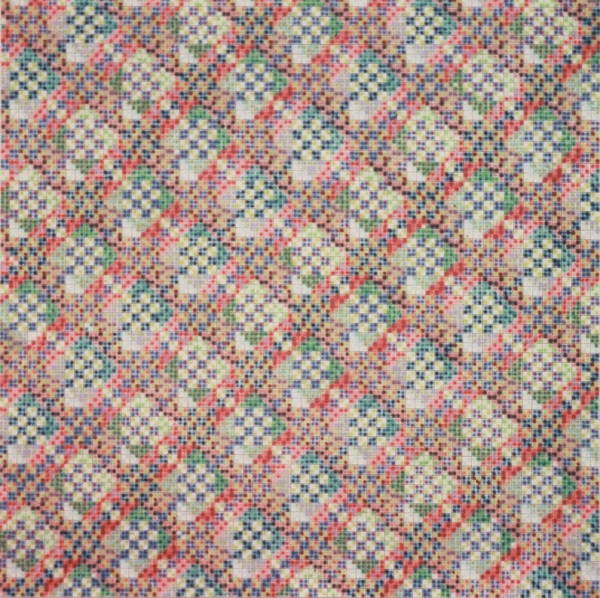
Logitec (1981?)

Alternate title (?): Logitex
Synthetic polymer paint on canvas, 162.5 x 162.5
National Gallery of Australia, Canberra [with Logitex installation]

This intricately ornamental picture, shown at both Tolarno and Solander (Canberra) in 1981 as Logitec (Arkley’s files contain slides with process dates Aug81 and Oct81), is apparently identical with the canvas subsequently incorporated into Logitex(table and chair tableau) (1980-84) [3/M].

The date of 1983 and size 175 x 175 recorded in 1983 and 1991 appear to be erroneous.

Provenance

  • purchased for NGA in 1984 (with Logitex installation)

Exhibited

  • HA Tolarno 7/81, cat.1 (Logitec)
  • HA Solander, Canberra, 10/81, cat.4 (Logitec)
  • Canberra 8/83 (‘A Melbourne Mood’: dated 1983, size given as 175 x 175; with installation)
  • HA Monash 1991, cat.52 (dets. as for Canberra 8/83)
  • HA retrospective 2006-7 (shown in Melbourne only, with installation; size of canvas given as 162.5 x 162.5 x 7.5)

Literature

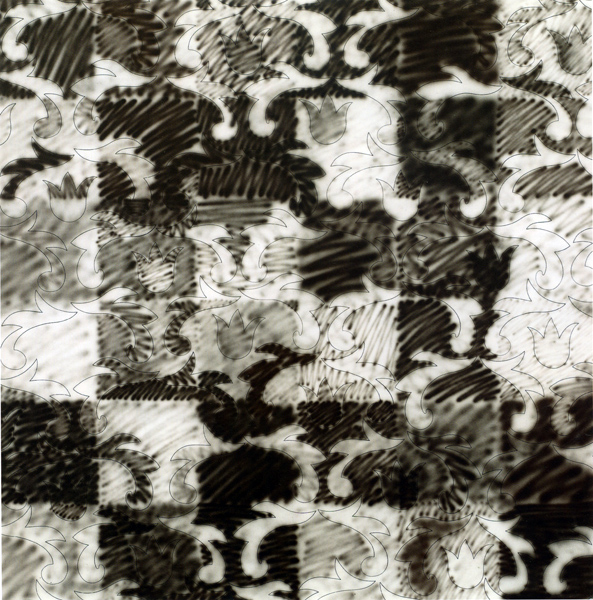
Leaves and Flowers 1981

Synthetic polymer paint on canvas, 161.0 x 160.5

Signed, dated and titled (on verso: ‘Howard Arkley 1981 / Leaves and Flowers / 160cm x 160cm / Acrylic on canvas’ [Mossgreen 6/15])

Private collection, Sydney

This work, first shown in Arkley’s “Recent Works” exhibition at Tolarno in July 1981, was previously identified provisionally via the artist’s archive photographs.

In June 2015, it appeared in a Bonhams auction featuring works from private collections curated by John Cruthers (see also Lattice and Grids 1980 [aka ‘Lattices’]). Despite being in very good condition (considering its age), the canvas failed to reach its auction estimate, perhaps because it was seen as “atypical” (Raffan 2015).

In fact, it is an intriguingly transitional work, marking the shift from Arkley’s more minimal early manner through to the decorative tendencies of his late 1970s/early 80s style. Ashley Crawford, discussing the present work in the 2015 Bonhams auction catalogue, comments: “[u]sing his trademark spray technique, each of the 36 panels is marked via a different level of intensity, from the minimal to the baroque.” A similar variety of sprayed and linear monochrome detailing may be observed in Arkley’s earlier corpus of ‘white’ works on paper: see now ‘White’ works on paper (c.1974-78).

The black and white grid treatment here is also clearly reminiscent of the door-format Curvilinear with Grid 1978.

Provenance

  • artist’s collection
  • Niagara Galleries, Melbourne
  • acquired by present owner in 1989 [presumably identical with a work listed as ‘Black & White (Floral)’ in book of sales in Arkley’s archive as sold via Niagara in April 1989 for $7,000]
  • auctioned by Bonhams, Sydney, 16 June 2015, lot 8 (reproduction and details as shown here; est.$30-40,000; not sold)

Exhibited

  • HA Tolarno 7/81, cat.10

Literature

  • Crawford 2015
  • Raffan 2015

Floral (1981)

Synthetic polymer paint on canvas, 163.4 x 162.8

Art Gallery of Western Australia, Perth [1990/0083]

This work, shown in HA Tolarno 7/81, deploys a similar pattern to Arabesque [aka Floral] 1979. It was purchased for Western Australia in 1990, joining Metallic 1981 and Ornamentic 1981 (both acquired the previous year).

Provenance

  • purchased for AGWA 1990 (via Tolarno?)

Exhibited

  • HA Tolarno 7/81, cat.9 (as 163 x 163)
  • (presumably) HA Quentin, Perth, 2/85, cat.4

Figurative 1981

Synthetic polymer paint on canvas, 200 x 120

signed, dated and titled [on reverse]

Coll.: unknown

It seems probable that the present painting, as shown at Metro 5 in 2002 and auctioned in 2003 (with photo and details as shown here), is the one first exhibited as ‘Figurative’ at Tolarno in July 1981, though it is not visible in the 1981 installation photos, and the other canvases in that exhibition were c.160 cm square.

See also the diptych Primitive Gold / Primitive Silver 1981 (Buxton Collection, Melbourne), and Primitive Silver 1984 (shown in Perth in 1985). All these works are obviously closely related to Primitive [mural] (1981) [W/P] and Primitive Silver 1982.

Provenance

  • P/C Sydney (acc.to Metro 5, 2002, and Sotheby’s 2003)
  • auctioned by Sotheby’s, Sydney, 25 Aug.2003, lot 147 (details as above; ill.; est.$20-30,000: sold for $23,000 plus buyer’s premium)

Exhibited

  • (probably) HA Tolarno 7/81, cat.12: as ‘Figurative’ (see comments above)
  • HA Metro 5, Melbourne, 2/02, cat.15: as ‘Figurative 1981’ (priced at $80,000)

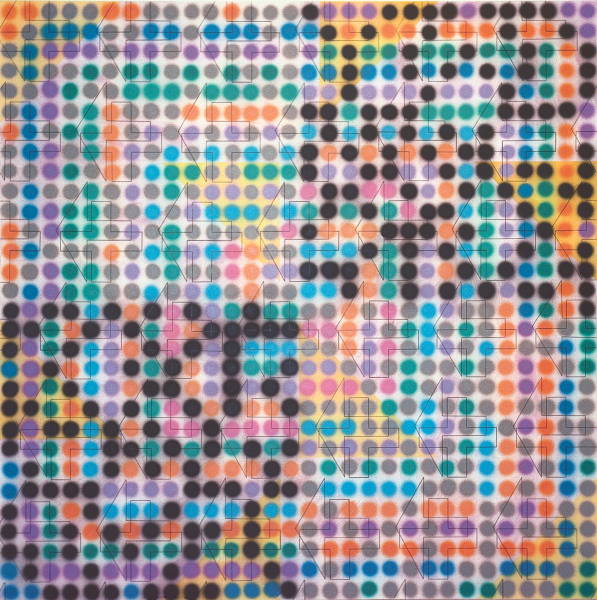
Disco (1981)

Synthetic polymer paint on canvas, 160 x 160

Collection of Elaine Baker and John Cruthers, Sydney

This painting, first shown in Arkley’s solo show at Tolarno in July 1981, was developed from a complex blend of references, ranging from the Disco music of the day, to pattern painting and Op Art. For more detailed discussion of these influences, see Crawford & Edgar (Spray 38); see also Carnival 104, commenting specifically on the colour.

Provenance

  • acquired 1988 via Niagara Galleries [acc.to NGV exh.files 2006]

Exhibited

  • HA Tolarno 7/81, cat.5
  • HA retrospective 2006-7 (shown in all 3 venues)
  • HA TarraWarra 12/15-2/16

Literature

  • Spray 38-9 (as noted above; including ill.)
  • Carnival 104 and Fig. 3.16

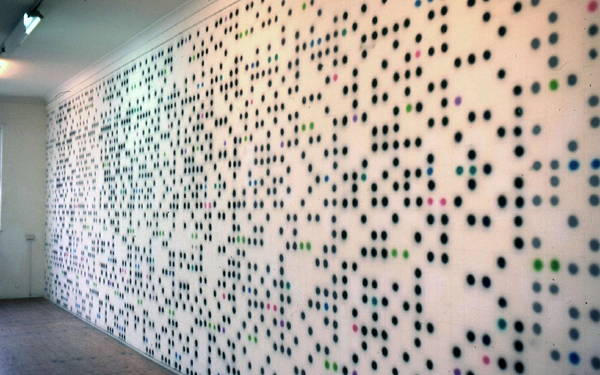
Wall Painting (Muzak Mural) (1981) [3/M]

Synthetic polymer paint on wall

Formerly Institute of Modern Art, Brisbane

This work was commissioned by John Nixon, then director of the IMA, and a central figure in Australian minimalist and conceptual art in this period (and since). The exhibition brochure includes a significant catalogue essay by Paul Taylor (subsequently reprinted in Duncan 1991), and a reproduction of a related work on paper: Untitled [study for Muzak Mural] 1981 [W/P].

Arkley’s files contain extensive photographic documentation of this mural and its production. For further discussion, see comments in Spray 46-7, and Carnival 64-5 (discussing the work in the context of late 1970s/early 80s minimalism and conceptualism).

Provenance

  • (see comments above)

Exhibited

  • Institute of Modern Art, Brisbane, 7-30 July 1981

Literature

  • Taylor, ‘Howard Arkley – Muzak Mural’ 1981 (exh.cat.)
  • Duncan 1991 (HA Monash exh.cat.), 12-13 (reprinting Taylor’s 1981 catalogue essay; with installation photo)
  • Spray 46-47 (inc. installation photos)
  • Carnival 64-5 (incorrectly identifying the commissioning curator as Peter Cripps) and Fig.2.12

Untitled [installation] (1981) [3/M]

Synthetic polymer paint on canvas and wood, vinyl floor tiles, 90 x 240 overall

{no longer extant in this form}

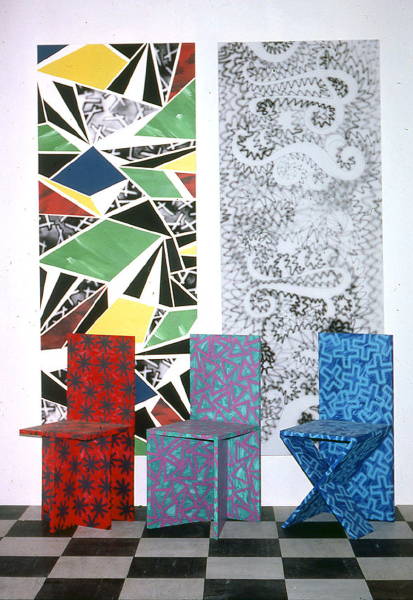
When exhibited at the Australian Perspecta exhibition in Sydney in May 1981, as shown here (via photos taken at the time), this installation comprised 50’s (1979), Arabesque 1979 [Curvilinear], and 3 of the chairs (T, V, X) later incorporated into Muzak Mural – Chair Tableau (1980-81) [3/M].

Slides in Arkley’s archive dating from March and May 1981 document other alternative configurations, using Bodgie 1979 and Arrows and Crosses 1980 instead of one or both of the canvases finally chosen.

This installation was evidently a precursor for Muzak Mural – Chair Tableau (1980-81) [3/M], as finally resolved in July 1981, and subsequently purchased for the NGV (for further discussion, see main entry for that work under 1980; and comments in Carnival 64).

Provenance

  • (see comments above)

Exhibited

  • Art Gallery of New South Wales, Sydney, May 1981 (Australian Perspecta), cat.nos.13-15

Literature

  • Murphy 1981 (Perspecta exh.cat.): 40-41

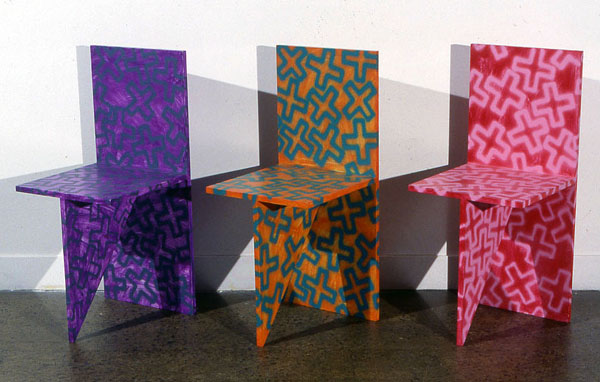
Four Chairs (1981-91) [3/M]

Synthetic polymer paint on wood, each 86.5 x 38.2 x 38

Collection details as noted below

The catalogue of the 1991 Arkley survey at Monash lists a set of four chairs, all noted as in the artist’s collection, with the details noted above.

An installation photo taken at the time for the Monash Visual Arts slide library (reproduced here) shows only three chairs, suggesting that the fourth was not completed in time for the exhibition: see below.

The three photographed in 1991 all include a triangular leg supporting the seat, and painted decoration with sprayed cross forms in various colours. Of the three, the current whereabouts of the purple and red chairs is unknown. But the central orange/green chair reappeared in a Deutscher and Hackett auction in August 2015, and is now held in the collection of the Art Gallery of South Australia: see Chair (1991) [3/M].

It seems probable that the fourth chair originally intended to be included in the Monash show is Untitled (Chair) (1991) [3/M], an unfinished example, with the same design and similar dimensions, auctioned in Melbourne in 2009.

NB Chair (1980) [3/M] was a separate, differently-structured work, also included in HA Monash 1991 (cat.21).

Exhibited

  • HA Monash 1991, cat.81: details as above

‘Howard Arkley: Recent Works’, Solander Gallery, Canberra, Oct.-Nov.1981

‘Howard Arkley: Recent Works’, Solander Gallery, Canberra, 16 Oct.-1 Nov.1981

This exhibition reprised the patterning theme of Arkley’s July 1981 show at Tolarno, including five canvases and a work on paper (no.12) first shown there, but with the addition of several new works on paper. In reality, though, the Solander show documents a phase of Arkley’s career that had already been surpassed, given the exhibition of Primitive [mural] (1981) [W/P] in July.

The Solander show was reviewed astutely in the Canberra Times by Sonja Kaleski (1981), who commented on the works’ Op lineage and visual intelligence, noting the important role played by the black dots, lines and grids in emphasising the picture surface (in contrast with the air-brushed patterning and spatial effects).

Arkley’s archive includes a partial set of installation slides, and slides of several of the individual works, almost all with process dates of Oct.1981, assisting with identification, although two works on paper (nos.10 and 11) remain unidentified at this stage. The check-list (in Arkley’s archive) indicates that nos. 1-5 were acrylic on canvas, each 160 x 160 cm, each priced at $1000; nos. 6-10: acrylic on paper, 80 x 104 cm, each $400; nos. 11-12: acrylic on paper, 88 x 115 cm, also $400 each.

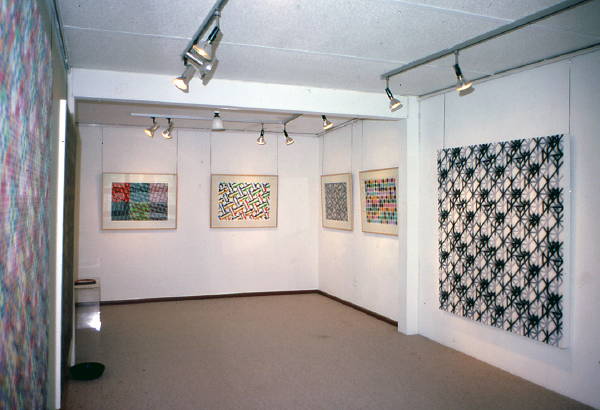
(photo: installation shot showing, from left, cat.nos. 4, 5, 6, 7, 10 (?), 9 and 2 [archive slide])

1. Vortex 1981: first shown at Tolarno 7/81

2. Science 1981: also shown at Tolarno 7/81

3. Ornamentic 1981: also shown at Tolarno 7/81

4. Logitec: see Logitec (1981?); this is presumably the canvas first exhibited at Tolarno 7/81 (also as Logitec) and later incorporated into Logitex installation (1980-84) [3/M] (now NGA); slides in Arkley’s files are dated August & Oct.1981

5. Metallic 1981: also first shown Tolarno 7/81

6. Lattice (1981) [W/P]: slide in Arkley’s archive with process date Oct81; this is a small variant of Lattice and Grids (1981)

7. Weaving 1981 [W/P]: this work, which was purchased directly from the Solander exhibition, appears in several of the installation shots, and a detail was reproduced in black and white on the exhibition invitation (see Arkley files). However, an archive slide previously thought to show this work, with process date Mar81, has now been identified as a reproduction of the related work Untitled [Weaving] 1980 [W/P]: refer entries for both works incorporating new documentation received in 2025.

8. Printout (1981) [W/P]: Arkley’s archive includes a slide with process date Aug80 (also visible in Solander installation photos); one of a number of work-on-paper variants of Printout 1981

9. Disco (1981) [W/P]: visible in installation slide (as reproduced above), with process date Oct81; work-on-paper variant of Disco 1981

10. Primitive [small] (1981) [W/P]: 80 x 104 cm acc.to check-list; unidentified; this was most likely a small variant of Metallic 1981, visible third from right in the installation photo shown here, and not otherwise accounted for; it was clearly not the large mural drawing shown at Prahran in July-August 1981.

11. Figurative (1981) [W/P]: 88 x 115 cm. acc.to check-list; unidentified; possibly a variant of the canvas shown at Tolarno in July: see Figurative (1981) [aka ‘Primitive Silver’?]. However, no such work on paper appears to be extant. Alternatively, this could be identical with a work on paper auctioned by Christie’s in June 2002: see now Untitled [‘Abstract’] 1981 [W/P], an attributed work signed and dated 1981, and based on a pattern similar to that used for Ornamentik (1981); the size given by Christie’s, 59.5 x 86, does not seem consistent with the Solander entry, but there are similar discrepancies for other works from this show (see eg. no.12).

12. Redwedge = Red Wedge [#1] 1981 [W/P], first shown at Tolarno in July 1981 (cat. no.11).

‘Howard Arkley: Recent Works’, Tolarno, July 1981

‘Howard Arkley: Recent Works’, Tolarno Galleries, 98 River Street, South Yarra, 4-25 July 1981

This exhibition, Arkley’s first at Tolarno’s new River Street premises, featured a series of large paintings, most of them about 160 cm (6 feet) square, marking the culmination of Arkley’s pattern-making phase, together with the contemporaneous Wall Painting (Muzak Mural) (1981) [3/M].

Identification of works is facilitated by file photos, including several installation shots, slides of various individual works (some with process date August 1981), and shots of him posing in front of two of his own favourite works from this series, Disco (1981) and Metallic 1981.

For reviews of this exhibition, see Millar and Rooney (refer bibliography); the latter, in a key critical appraisal, commented on the artist’s sophisticated and sustained exploration of ‘the complex interplay between the structure and content of modernist abstraction and the patterns and images of mass culture,’ also noting the importance of ‘wit and parody’, and feminist influences, in Arkley’s developing work.

Details of works listed below are based on the list in Duncan 1991: 29 (the original check-list does not appear to be extant). Five of the canvases and a drawing from this exhibition were also included in Arkley’s show at Solander, Canberra, later in 1981 (see separate entry).

(photos: Arkley, Georges and William Mora sitting ‘in’ Muzak Mural – Chair Tableau (1981), cat.no.13; installation shot showing, from left, cat. nos. 2, 1, 11 [part] and 10 [Arkley archive])

1.      Logitec (1981?), now part of the installation Logitex (table and chair tableau) (1980-84) [3/M] (NGA, Canberra). Arkley’s slides of the painting have process dates August and October 81, the latter presumably taken at Solander later in the year.

2.      Science 1981. Also shown at Solander Oct.-Nov.1981; Arkley’s archive includes slides with process dates March and Oct.1981. The painting was reproduced on the Tolarno exhibition invitation (copy in artist’s files).

3.      Vortex 1981 (also shown at Solander Oct.-Nov.81)

4.      Lattice and Grids 1980 (subsequently shown in HA Monash 1991 as Lattices).

5.      Disco (1981): archive slide dated Aug81.

6.      Metallic 1981: archive slides (and installation shot from Solander Oct.-Nov.1981, where it was also shown). Acquired for AGWA 1989.

7.      Ornamentic 1981: also shown at Solander, Oct.-Nov.1981; acquired for AGWA 1989.

8.      Printout 1981 (Sydney, Artbank collection)

9.      Floral (1981): no archive photos; acquired for AGWA 1990

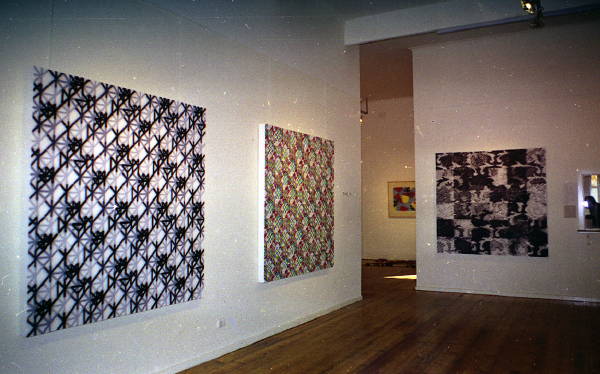
10.   Leaves and Flowers 1981: photos in Arkley’s archive, including the installation photo reproduced above

11.   Red Wedge (Carpet and Drawings): for the rug, see Logitex (a hooked rug) (1981) [3/M], now incorporated in Logitex (table and chair tableau) (1980-84) [3/M] (NGA). The drawing visible in the installation photo (see above) is Red Wedge [#1] 1981 [W/P], also shown at Solander later in 1981. Unfortunately, none of the other drawings shown can be seen in the installation shot; they may have included Untitled [Red Wedge study] (1981?) [W/P] and/or one of more of the smaller sketches still in the artist’s studio collection at his death, noted under minor works on paper (1981).

12.   Figurative: provisionally identified here as Figurative 1981; although it is not square in format, this canvas seems the likeliest candidate.

13.   Musak (sic) Mural and Chairs X, T, W, V: evidently the first exhibition of the NGV installation Muzak Mural – Chair Tableau (1980-81) [3/M], in its definitive form, as suggested by the photographic evidence in Arkley’s files, including a slide of the final work with process date Aug81, and several undated photographs of the artist sitting ‘in’ the installation with Georges Mora and William Mora, also apparently taken at Tolarno (example reproduced here).