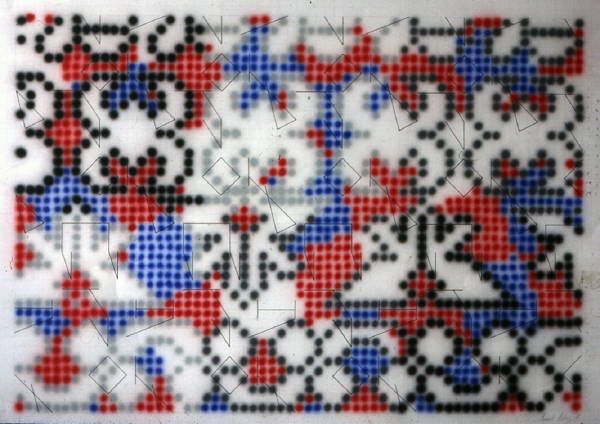
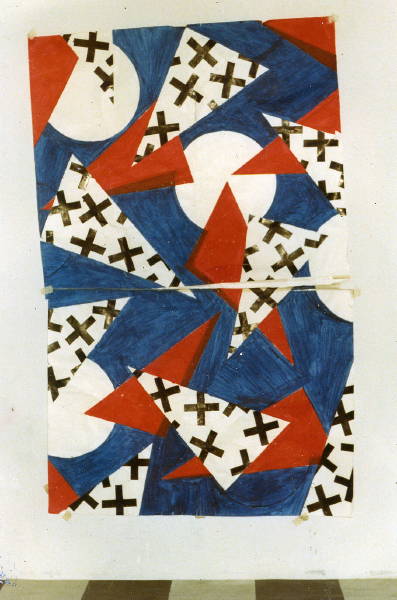
Untitled [Red Wedge study] (1981?) [W/P]

Synthetic polymer paint on 2 sheets of paper, {size unknown}
Coll.: unknown

This large work-on-paper sketch (possibly originally measuring about 170 x 120 cm) may have been one of the ‘Red Wedge’ drawings shown at Tolarno 7/81 with Logitex (a hooked rug) (1981) [3/M], whose composition is clearly similar. However, the present work is not visible in the installation photos for the Tolarno show, and it is unclear whether it is still extant.

Arkley’s undated archive photo (inscribed by Arkley on the reverse: ‘Drawing / Title Red wedge’), as reproduced here, is comparable with several other photos, also dating from c.1981, showing other works with the same tiled floor, including Untitled [Geometric pattern] (1981?), and Untitled [Red Wedge] (1981?), another related work.

[NB the present drawing was previously listed as Red Wedge [#2] (1981?) [W/P]; entry revised Dec.2023]

Provenance

  • unknown

Exhibited

  • (possibly) HA Tolarno 7/81, as part of cat.11 (see comments above)

Red Wedge [#1] 1981 [W/P]

Synthetic polymer paint on paper, 68.0 x 96.0 

signed, dated and titled [insc.l.r., below image: ‘Howard Arkley 81’; and verso: ‘Title Drawing for a Carpet 81 (April) / Howard Arkley’]

Collection unknown [last auctioned March 2024]

This work was first exhibited in Arkley’s ‘Recent Works’ show at Tolarno, 4-25 July 1981, as one of several works on paper related to Logitex (a hooked rug) (1981) [3/M].

The composition of the present work echoes that of the rug, but with variant details and a somewhat different colour scheme. Later in 1981 (16 Oct.-1 Nov.), the drawing was shown again, this time on its own, in Arkley’s solo exhibition at the Solander Gallery, Canberra, under the title ‘Redwedge.’

See also Red Wedge [#2] 1981 [W/P], a variant first shown in Arkley’s 1991 Monash University survey exhibition, and Untitled [Red Wedge study] (1981?) [W/P].

NB the present work was first listed in this catalogue as Redwedge [#1] 1981 [W/P], incorrectly including a photograph of the variant shown at Monash in 1991 (and some details relating to that version). For the ID photo and revisions included here I am grateful to Clementine Retallack, Menzies Art Brands [revised entry, Dec.2023/March 2024].

Provenance

  • Artist’s collection
  • Private collection, Melbourne (gift from the artist, c.1985/6?)
  • Thence by descent, private collection, Melbourne
  • Auctioned by Menzies, Melbourne, 27 March 2024, lot 104 (details and ill.as shown here; est.$12-18,000; sold for $13,500 + B/P)

Exhibited

  • HA Tolarno 7/81, as a component of cat.no.11:  ‘Red Wedge (carpet and drawings’)
  • Solander 10/81, cat.12 (as ‘Redwedge’)

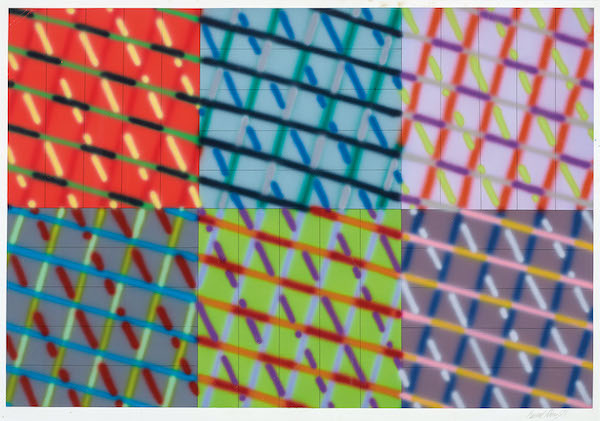
Printout 1981 [W/P]

Synthetic polymer paint on paper, 80 x 104

signed and dated [l.r., below image: ‘Howard Arkley 81’]

Coll.: unknown

This work is closely related to both Printout II 1980 and Printout – Drawing for Decorated Tram 4 (1980) [W/P]; see also Printout 1981 and other related works from this period.

Arkley’s archive contains a slide of this drawing with process date Oct81, presumably taken at the Solander exhibition.

Provenance

  • unknown

Exhibited

  • HA Solander 10/81, cat.8 (details as above; $400)

Primitive [small] (1981) [W/P]

Synthetic polymer paint on paper, 80 x 104

Coll.: unknown

A Solander installation photo (see main exhibition entry) suggests that this was probably a small variant of Metallic 1981. Alternatively, it may have been a small version of Primitive [mural] (1981) [W/P], although no such work seems to be extant.

Provenance

  • unknown

Exhibited

  • Solander 10/81, cat.10 (details as above; $400)

Primitive [mural] (1981) [W/P]

Synthetic polymer paint on paper, 150 x 560 (originally on 20 sheets, each 75 x 56; one sheet now missing)

Private collection, Melbourne

Widely acknowledged as a key work in Arkley’s development, this large-scale drawing is reproduced here as installed at Prahran CAE in July 1981 (slides with process date Aug81). Elements of the artist’s everyday and imaginative life are drawn expansively, using a black air-brushed line.

The authors of Spray (clearly relying on the artist) consider the genesis and imagery of the work in detail, describing it as the product of ‘one night of frenetic outpouring’, discussing the various circumstantial events referenced (a telephone, a knock at the door, and so on), and identifying the title as borrowed from a song by Punk band The Cramps. Arkley, as quoted in Spray, later claimed that ‘this work set off my career’; and it clearly signalled a radical shift from his previous non-figurative practice. In fact, its production and display coincided exactly with the exhibition of several of his mature pattern-dominated works, at Tolarno in Melbourne, and Brisbane’s IMA: see now ‘Howard Arkley: Recent Works’, Tolarno, July 1981, and Wall Painting (Muzak Mural) (1981) [3/M].

In an extended analysis in Carnival (2006), I relate the teeming iconography of the present work to aspects of the carnivalesque traditions of ‘grotesque’ humour and sexuality (as analysed by Russian cultural theorist Mikhail Bakhtin), noting the origins of much of the imagery in Arkley’s 1970s diaries and sketchbooks, and (conversely) emphasizing the significance of the large scale on which this work is conceived.

In the catalogue of the 2015-16 Arkley exhibition at TarraWarra, I reconsider the key place of this work in Arkley’s oeuvre. Downplaying the mythic story of its creation, I emphasize instead its relationship to fundamental critical developments of the period, notably Paul Taylor’s theorization of Arkley and his peers as ‘New Wave’ and ‘Popist’. I conclude that music historian Simon Reynolds’ notion of ‘postpunk’ is probably the most valuable frame of reference within which to consider Primitive and Arkley’s subsequent figurative development through to 1984. See also Chris McAuliffe’s essay on Arkley and music, also in the TarraWarra catalogue: see Fitzpatrick & Lynn 2015 as cited below.

Arkley is quoted in Spray as saying the work had been reduced to a ruined set of fragments by the 1990s, necessitating the production of a ‘replica’ for the ‘White + Black’ show at Tolarno in 1995: see Primitive (1995) [W/P]. After his death, however, the original work was rediscovered in his studio, admittedly in poor shape, with one sheet missing, several others badly damaged, and masking tape adhered to others. Nevertheless, the overall effect was extraordinarily impressive, and the decision was made to restore the work for the Arkley retrospective in 2006-7, shown there, and subsequently, with the missing sheet (3rd from the right on the bottom row) replaced by a facsimile.

Provenance

  • artist’s collection
  • Private collection, Melbourne
  • Private collection, Melbourne, 2019 (acquired from the above)

Exhibited

  • Prahran CAE, 7/81
  • HA retrospective 2006-7 (restored; as 120.5 x 403 cm; shown at all 3 venues)
  • HA TarraWarra 12/15-2/16

Literature

  • Spray 6-9 (including the quotes above; with ill.)
  • Carnival 165-69 and Figs.6.6 and 6.8-10 (details)
  • Smith 2006:14-15 (inc.ill.)
  • NGVA Arkley audio-guide 2006 (comments by Ashley Crawford, Jason Smith & Ray Edgar)
  • Fitzpatrick & Lynn, Howard Arkley and Friends (2015), pp.26-28 (John Gregory: ‘Popism, Postpunk and Primitive‘) and 30-38 (Chris McAuliffe,’Raw power meets electronic music sounds: Howard Arkley and popular music’), esp.34
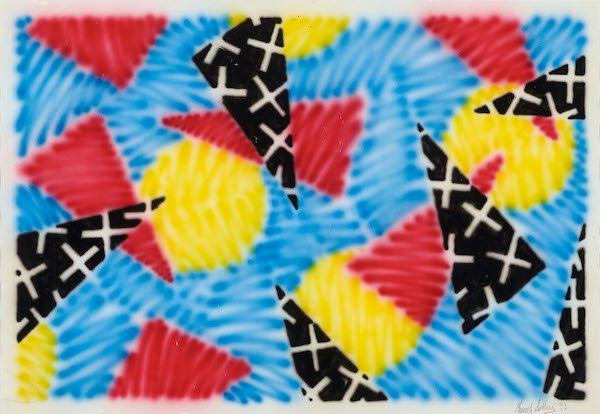
Lattice 1981 [W/P]

Synthetic polymer paint on paper, 61.5 x 87

Signed & dated l.r.: ‘Howard Arkley 81’

Collection unknown [last auctioned March 2024]

Arkley’s files include a slide with process date Oct81 (also visible in Solander 10/81 installation shots). The composition is obviously related to Lattice and Grids 1980 [aka ‘Lattices’]; see also Design (in 2 sections) for a Tapestry 1983 [W/P].

The provenance details shown below were confirmed in an email from Menzies Art Brands, Dec.2023, noting that Red Wedge [#1] 1981 [W/P] is in the same collection; many thanks to Clementine Retallack, Menzies Art Brands, for forwarding details and a new photo.

Provenance

  • Artist’s collection
  • Private collection, Melbourne, gift from the artist
  • Thence by descent, private collection, Melbourne
  • Auctioned by Menzies, Melbourne, 27 March 2024, lot 105 (details and ill.as shown here; est.$15-20,000; sold for $16,000 + B/P)

Exhibited

  • HA Solander 10/81, cat.6 (as measuring 80 x 104; $400)

Figurative (1981) [W/P]

Synthetic polymer paint on paper, 88 x 115

Coll.: unknown

Unidentified; possibly = Untitled [‘Abstract’] 1981 [W/P], as noted below. Alternatively, this may have been a work-on-paper variant of Figurative [aka ‘Primitive Silver’?] 1981.

The Spray research card (c.1996; copy in Arkley’s files) lists this work as a ‘drawing for wall painting’.

Provenance

  • unknown

Exhibited

  • HA Solander 10/81, cat.11 (details as above; $400)

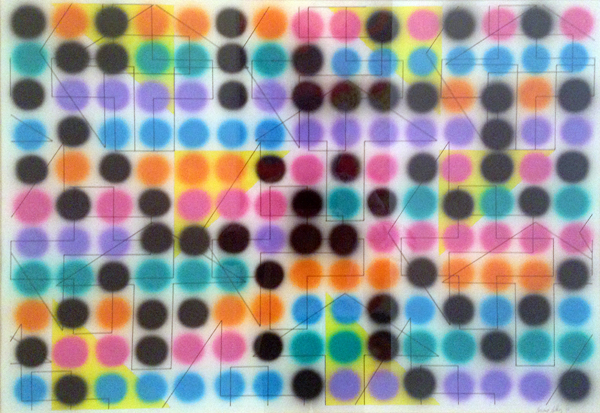
Disco (1981) [W/P]

Synthetic polymer paint on paper, 80 x 104

Private collection, Canberra

This work, evidently similar in its patterning to Disco (1981), is visible in the installation photos taken at HA Solander 10/81.

Provenance

  • unknown

Exhibited

  • HA Solander 10/81, cat.9 ($400)
  • HA TarraWarra 12/15-2/16

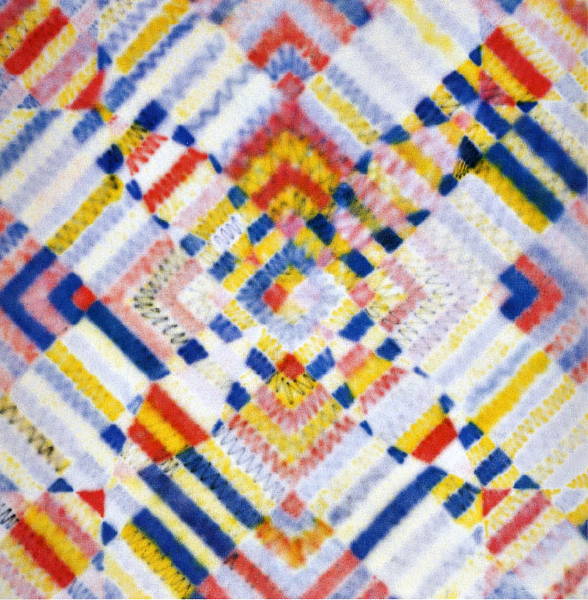
Vortex 1981

Synthetic polymer paint on canvas, 161.5 x 161.7

Signed, dated and titled [on reverse: ‘Howard Arkley 81 / Vortex’]

Private collection, Brisbane

The authors of Spray comment on the complex blend of Op Art and domestic references here, citing the main source as an Amish quilt book Arkley recalls buying in New York. Ray Edgar, speaking on the audio-guide for the Arkley retrospective in 2006, pointed to the contradictory range of influences involved, from Mondrian to feminism.

The painting was shown in both HA Tolarno 7/81 and Solander 10/81 (see archive photos).

Provenance

  • recorded in current coll.in NGVA Arkley retrospective files 2006

Exhibited

  • HA Tolarno 7/81, cat.3
  • HA Solander 10/81, cat.1
  • HA Quentin 2/85, cat.2
  • HA Monash 1991, cat.38 (details as above)
  • HA retrospective 2006-7 (shown at all 3 venues)

Literature

  • Spray 36-7 (as cited above; inc.ill.)
  • NGVA Arkley audio-guide 2006 (comments by John Gregory, Lily Mae Martin & Ray Edgar)

Untitled [Red Wedge] (1981?)

Synthetic polymer paint on canvas (?), c.160 x 160?

Coll.: unknown

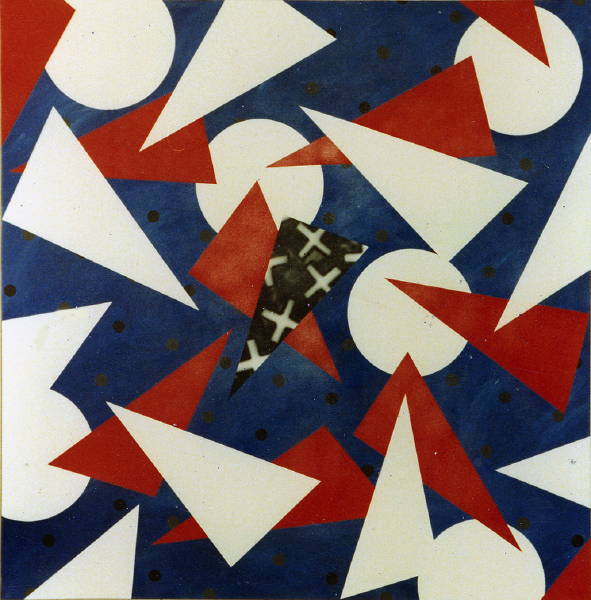
Arkley’s studio photo (reproduced here), the sole source, is undated but probably dates from c.1981, and seems to show the work in process, with only the central triangle completed in detail. It is unclear whether the work was ever completed, and whether it is extant.

In the absence of further documentation, it is obviously difficult to be sure of the work’s intended final form, but it appears to have been conceived as a large-scale variant of the composition originally developed in Logitex (a hooked rug) (1981) [3/M], Red Wedge [#1] 1981 [W/P], Red Wedge [#2] 1981 [W/P], and Untitled [Red Wedge study] (1981?) [W/P].

The evidence provided by the file photo, featuring the same tiled flooring as in other archive photos of Arkley works dating from around 1981 such as Untitled [Geometric pattern] (1981?), and comparison with other extant canvases from this period, suggests that this was also on canvas, about 160 cm square.

Provenance

  • unknown